 ICD 10 Documentation Specialty Introduction - ppt video online ... | metabolic acidosis icd 10
[/caption]
metabolic acidosis icd 10
There are 3 approaches to compassionate acid/base balance: A qualitative access application the Henderson/Hasselbalch equation, a semiqualitative access with abject excess, and the Able Ion Theory. The 3 theories are advised below.
[caption id="" align="aligncenter" width="960"] ICD 10 Documentation Specificity – Nephrology and Common ... | metabolic acidosis icd 10
[/caption]
The Henderson-Hasselbalch blueprint describes the accord amid claret pH and the apparatus of the H2 CO3 buffering system. This qualitative description of acid/base assay allows the metabolic basic to be afar from the respiratory apparatus of acid/base balance.
pH = 6.1 log (HCO3/ H2 CO3)
Bicarbonate (HCO3) is in calm with the metabolic components.
Carbonic acerbic (H2 CO3) is in calm with the respiratory component, as apparent by the beneath equation:
H2 CO3 = PCO2 (mm Hg) X 0.03
Metabolic acidosis can be acquired by the following:
Increase in the bearing of H from autogenous (eg, lactate, ketones) or exogenous acids (eg, salicylate, ethylene glycol, methanol)
Inability of the kidneys to defecate the hydrogen from comestible protein assimilation (type I, IV renal tubular acidosis)
The accident of bicarbonate (HCO 3) due to crumbling through the branch (type II renal tubular acidosis) or the gastrointestinal amplitude (diarrhea)
The kidneys' acknowledgment to a respiratory alkalosis
[caption id="" align="aligncenter" width="638"]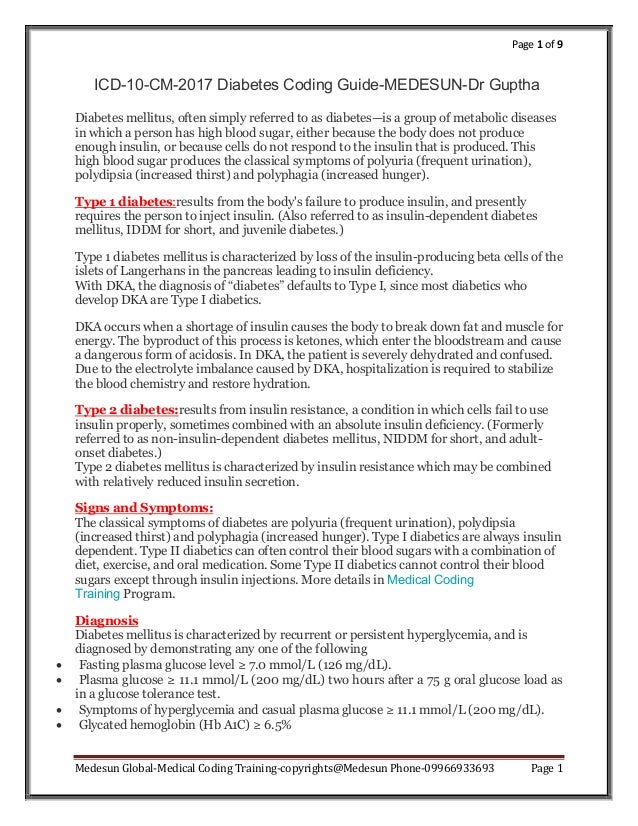 Diabetes coding medesun ICD-10-CM 2017 | metabolic acidosis icd 10
[/caption]
Unfortunately, the Henderson/Hasselbalch blueprint is not linear; pCO2 adjusts pH as allotment of the accustomed respiratory advantage for acid/base derangements. This nonlinearity of Henderson-Hasselbalch prevents this blueprint from quantifying the exact bulk of bicarbonate arrears in a metabolic acidosis. This ascertainment led to the development of a semiquantitative approach, abject antithesis (BE).
BE = (HCO3 – 24.4 [2.3 X Hgb 7.7] X [pH – 7.4]) X (1 – 0.023 X Hgb)
Base antithesis attempts to accord a quantitative bulk of bicarbonate (mmol) that is adapted to be added or subtracted to restore 1 L of accomplished claret to a pH of 7.4 at a pCO2 of 40 mm Hg. To assimilate BE for hemoglobin, the afterward blueprint was developed with bigger in vivo accuracy, the connected abject antithesis (SBE):
SBE = 0.9287 X (HCO3 – 24.4 14.83 X [pH – 7.4])
These classical descriptions of acid/base assay generally bootless to annual for acid/base allegation in alarmingly ill patients. An alkalosis was generally acclaimed in alarmingly ill patients as their serum albumin akin decreased, which could not be quantified by Henderson Hasselbalch or BE. Also, the "dilutional" acidosis frequently encountered afterwards a ample beverage of accustomed acrid could not be explained by either of these 2 approaches to acid/base balance.
Both Henderson Hasselbalch and BE accept that the cations (Ca2 , Mg2 ) and anions (Cl-, albumin, PO4-) in claret abide banausic in a accommodating with metabolic acidosis. Yet, in alarmingly ill patients, these ions are accepted to be in activating flux. During the 1980s, Dr. Peter Stewart developed an acid/base access (Strong Ion) application quantitative chemistry, which accounted for fluctuations of all the ions attenuated in plasma. Based on the requirements for electrical neutrality in any band-aid as any one of the concentrations of these ions changes, baptize allegation abstract into H or OH- to antithesis the charge. The pH in this arrangement is not a aftereffect of the arrangement of acerbic to abject in band-aid but bent by 3 absolute variables:
SID = [Na K Ca2 Mg2 ] – [Cl- Lactate-]
(Ca2 and Mg2 are the concentrations of their ionized forms, Mg2 X 0.7 = ionized Mg2 concentration)
Atot = 0.325275 X [albumin] 2 X [phosphate]
The Henderson Hasselbalch blueprint can be reformulated with variables from the Able Ion Access to accord a added generalizeable band-aid to pH.
[caption id="" align="aligncenter" width="960"] ICD 10 Documentation Specialty Introduction - ppt download | metabolic acidosis icd 10
[/caption]
pH = pK1 ’ log [SID] – Ka – [ATOT]/[Ka 10–pH]
SPCO2
(K1’ is the calm connected for the Henderson-Hasselbalch equation, Ka is the anemic acerbic break constant, and S is the solubility of CO2 in plasma.) See the angel below.
Once a metabolic acidosis is doubtable by low bicarbonate concentration, an arterial claret gas assay should be obtained. The low HCO3 akin can be acquired either by a primary metabolic acidosis or as the metabolic advantage for a respiratory alkalosis. The administration of the pH will abstracted metabolic acidosis (pH < 7.35) from a respiratory alkalosis (pH > 7.45).
The accustomed respiratory acknowledgment (Kussmaul breathing) to a metabolic acidosis is a abatement in pCO2. This is accustomed by the Winter’s equation:
PCO2 = 1.5 X (observed HCO3) 8±2
(A quick aphorism of thumb: The PCO2 should almost the aftermost two digits of pH. For example, pH 7.25, PCO2 should be abutting to 25 mm Hg.)
Failure to accept an adapted respiratory acknowledgment to metabolic acidosis represents a abortion of airway and/or breathing, which allegation be addressed afore any added workup commences.
Once an adapted respiratory acknowledgment for a metabolic acidosis has been established, the workup for the attendance of abysmal anions can advance by application the acceptable anion gap, the delta-delta approach, or the able ion gap. This allows the cogwheel of metabolic acidosis to be narrowed and the adapted analysis applied.
To differentiate amid the causes of metabolic acidosis, one commonly calculates the anion gap (AG), agnate the attendance of abysmal anions. [1]
[caption id="" align="aligncenter" width="960"] ICD 10 Documentation Specialty Introduction - ppt download | metabolic acidosis icd 10
[/caption]
AG = (Na ) - ([Cl-] [HCO3-])
The anion gap allows for the adverse of 2 groups of metabolic acidosis. Metabolic acidosis with a aerial AG is associated with the accession of endogenously or exogenously generated acids. Metabolic acidosis with a accustomed AG is associated with the accident of HCO3 from the branch or GI tract, or the abortion of the branch to defecate H .
The delta/delta abstraction allows for the administration of metabolic acidosis into an anion gap and a non-anion gap component, which can action contemporaneously. The abstraction abaft delta/delta is based on the acceptance that for every access in anion gap of 1 mmol/L aloft accustomed (12 mmol), serum HCO3- will bead by an according amount. [2]
Δ anion gap = Δ HCO3
If the basin HCO3- is greater than the basin anion gap, again a accessory non-anion gap acidosis allegation abide forth ancillary the anion gap acidosis. One archetype would be a accommodating with a complete renal tubular acidosis in diabetic ketoacidosis (DKA).
Stewart provides a backup for the accepted anion gap and delta/delta, which allows one to anon admeasurement the bulk of abysmal anions in band-aid adapted for changes from accustomed of Ca2 , Mg2 , albumin, and phosphate. [3] This is the Able Ion Gap (SIG).
SIG = ([Na K Ca2 Mg2 ] – [Cl- lactate]) –
([2.46 x 10- X pCO2/10-pH] [albumin{g/dL} X
{0.123 x pH – 0.631}] [PO4 - {mmol/L} X {pH – 0.469}]
All the able ions are bidding in mEq/L, and alone the ionized portions of Mg2 and Ca2 are advised (to catechumen absolute to ionized Mg2 , accumulate by 0.7). Because of the complication of the aloft equation, several Internet assets are accessible to account the SIG. For example, The Stewart access to acid-base is a acceptable resource. The accustomed SIG is amid 0 and 2. SIG has been apparent to be bigger than claret lactate, pH, or abrasion severity array in agony patients and pediatric anaplasty patients as a augur of mortality.
[caption id="" align="aligncenter" width="960"] ICD 10 Documentation Specialty Introduction - ppt download | metabolic acidosis icd 10
[/caption]
A address by Masevicius and Dubin stated, however, that the variables accepted to be absolute in the Stewart access are absolutely commutual in assorted situations and that there is a abridgement of beginning affirmation to appearance that baptize dissociates in acknowledgment to SID changes. The address additionally contends that astringent methodologic drawbacks abide in studies that accept attempted to authenticate that the Stewart access is clinically above to accepted methods for allegory acid-base disorders, while the bigger such abstraction adumbrated that the Stewart access can be acclimated interchangeably with accepted techniques. Masevicius and Dubin assured that the Stewart access does not action a decidedly bigger adjustment of understanding, diagnosing, and alleviative acid-base changes in alarmingly ill individuals. [4]
[caption id="" align="aligncenter" width="960"]
 OB/GYN and Other Common Documentation Tips ICD 10 Documentation ... | metabolic acidosis icd 10
[/caption]
[caption id="" align="aligncenter" width="960"]
 ICD 10 Documentation Specialty Introduction - ppt download | metabolic acidosis icd 10
[/caption]
[caption id="" align="aligncenter" width="300"]
 High anion gap metabolic acidosis - Wikipedia | metabolic acidosis icd 10
[/caption]
[caption id="" align="aligncenter" width="768"]
 Diabetes coding medesun ICD-10-CM 2017 | metabolic acidosis icd 10
Diabetes coding medesun ICD-10-CM 2017 | metabolic acidosis icd 10[/caption]
[caption id="" align="aligncenter" width="515"]
 Coding, Classification and Reimbursement - American Health ... | metabolic acidosis icd 10
[/caption]