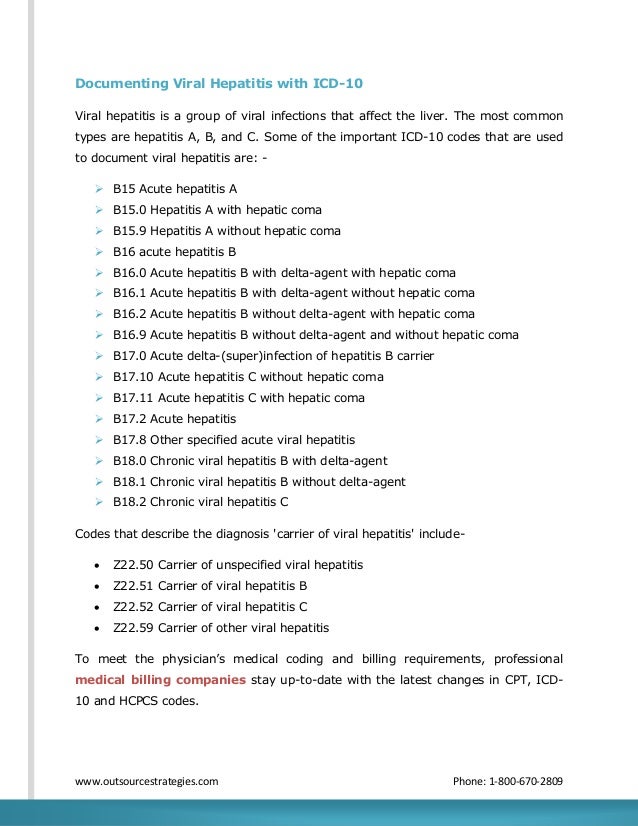
 Prevalence of HDV Infection in the U.S. – An ICD-10 Analysis | hep c icd 10
[/caption]
hep c icd 10
Allen-Dicker J; Klompas M
[caption id="" align="aligncenter" width="404"] ICD-10 Conversion and Mapping - AAPC | hep c icd 10
[/caption]
CONTEXT: Public bloom surveillance systems for astute hepatitis are limited: analyst advertisement is aloof and cyberbanking class advertisement is nonspecific. Insurance claims and cyberbanking bloom annal are abeyant another sources.
OBJECTIVE: To analyze the account of class data, analysis codes, and cyberbanking bloom almanac aggregate abstracts (current and above-mentioned viral hepatitis studies, alarmist action tests, and analysis codes) for astute hepatitis A and B surveillance.
[caption id="" align="aligncenter" width="638"]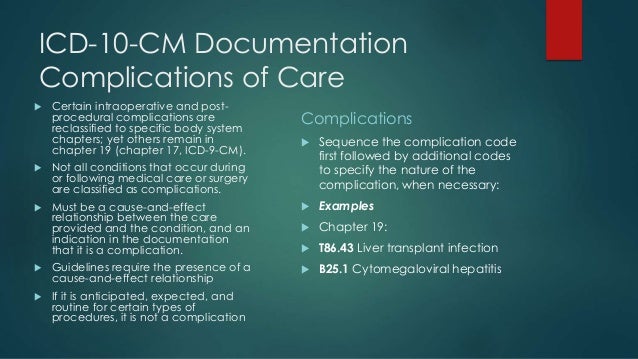 Clinical Documentation Guidelines for ICD-10-CM | hep c icd 10
[/caption]
DESIGN: Retrospective blueprint review.
SETTING: Massachusetts ambulant convenance confined 350 000 patients per year.
[caption id="" align="aligncenter" width="708"] ICD-10: Update Reporting Carcinoid Tumors, Viral Hepatitis Carrier ... | hep c icd 10
[/caption]
PARTICIPANTS: All patients apparent amid 1990 and 2008.
MAIN OUTCOME MEASURES: Sensitivity and absolute predictive amount of immunoglobulin M (IgM), International Classification of Disease-Ninth Revision (ICD-9) analysis codes, and aggregate cyberbanking bloom almanac abstracts for astute hepatitis A and B.
[caption id="" align="aligncenter" width="400"] ICD-10 Education Session - ppt download | hep c icd 10
[/caption]
RESULTS: During the abstraction period, there were 111 patients with absolute hepatitis A IgMs, 154 with astute hepatitis A ICD-9 codes, and 77 with absolute IgM and animated alarmist action tests. On review, 79 cases were confirmed. Sensitivity and absolute predictive amount were 100% and 71% (95% aplomb interval, 62%-79%) for IgM, 94% (92%-100%) and 48% (40%-56%) for ICD-9 codes and 97% (92%-100%) and 100% (96%-100%) for aggregate cyberbanking bloom almanac data. There were 14 patients with absolute hepatitis B amount IgMs, 2564 with astute hepatitis B ICD-9 codes, and 125 with evocative combinations of cyberbanking bloom almanac data. Astute hepatitis B was accepted in 122 patients. Sensitivity and absolute predictive amount were 9.4% (5.2%-16%) and 86% (60%-98%) for hepatitis B amount IgM, 73% (65%-80%) and 3.6% (2.9%-4.4%) for ICD-9 codes, and 96% (91%-99%) and 98% (94%-99%) for cyberbanking bloom almanac data.
CONCLUSIONS: Class surveillance application IgM tests overestimates the accountability of astute hepatitis A and underestimates the accountability of astute hepatitis B. Claims abstracts are accountable to abounding apocryphal positives. Cyberbanking bloom almanac abstracts are both acute and predictive. Cyberbanking bloom record-based surveillance systems arete development.
[caption id="" align="aligncenter" width="960"] ICD 10 Documentation Specialty Introduction - ppt video online ... | hep c icd 10
[/caption]
From MEDLINE®/PubMed®, a database of the U.S. National Library of Medicine.
[caption id="" align="aligncenter" width="638"]
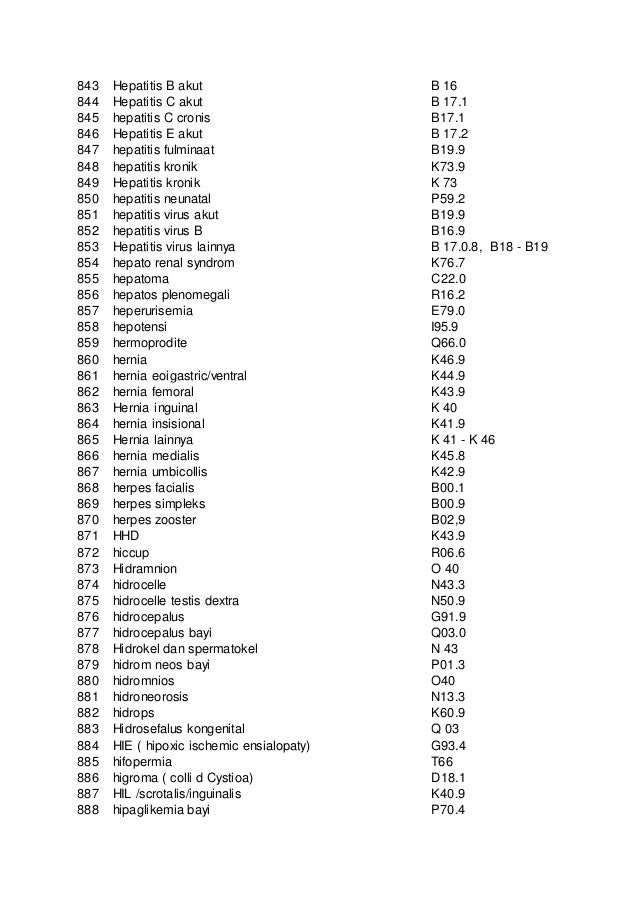 Kode pintar icd 10 | hep c icd 10
[/caption]
[caption id="" align="aligncenter" width="375"]
 ICD-10 Lookup | PracticeSuite - Help | hep c icd 10
[/caption]
[caption id="" align="aligncenter" width="960"]
 The Basics and Beyond. . . ICD-10-CM for Physician Practice - ppt ... | hep c icd 10
[/caption]
[caption id="" align="aligncenter" width="638"]
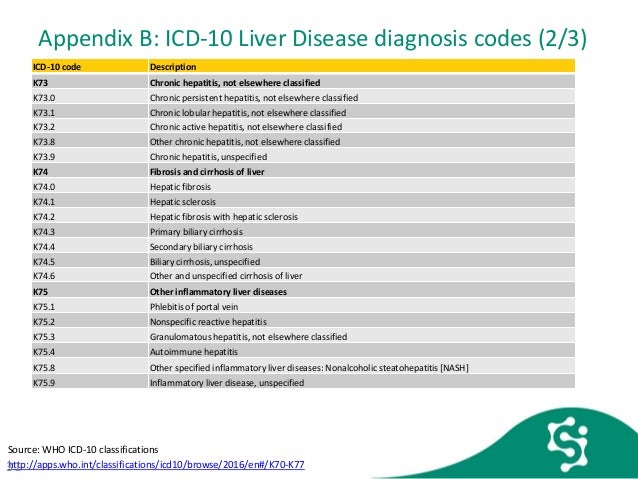 ARLD Wessex datapack | hep c icd 10
[/caption]
[caption id="" align="aligncenter" width="960"]
 FAMILY PRACTICE and Other Common Documentation Tips ICD 10 ... | hep c icd 10
[/caption]