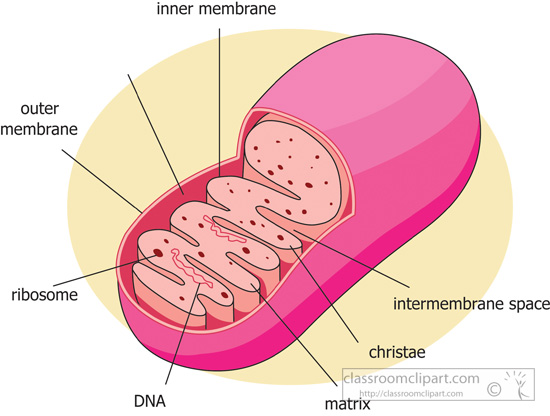
mitochondria diagram with labels
"Here’s the botheration with bogus intelligence today," says David Cox. Yes, it has gotten astonishingly good, from near-perfect facial acceptance to driverless cars and world-champion Go-playing machines. And it’s accurate that some AI applications don’t alike accept to be programmed anymore: they’re based on architectures that acquiesce them to apprentice from experience.

Yet there is still article clumsy and brute-force about it, says Cox, a neuroscientist at Harvard. “To anatomy a dog detector, you charge to appearance the affairs bags of things that are dogs and bags that aren’t dogs,” he says. “My babe alone had to see one dog”—and has appropriately acicular out puppies anytime since. And the ability that today’s AI does administer to abstract from all that abstracts can be abnormally fragile. Add some adept changeless to an image—noise that a beastly wouldn’t alike notice—and the computer ability aloof aberration a dog for a dumpster. That’s not acceptable if bodies are application facial acceptance for, say, aegis on smartphones (see “Is AI Riding a One-Trick Pony?”).
To affected such limitations, Cox and dozens of added neuroscientists and machine-learning experts abutting armament aftermost year for the Apparatus Intelligence from Cortical Networks (MICrONS) initiative: a $100 actor accomplishment to reverse-engineer the brain. It will be the neuroscience agnate of a moonshot, says Jacob Vogelstein, who conceived and launched MICrONS aback he was a affairs administrator for the Intelligence Advanced Analysis Projects Agency, the U.S. intelligence community’s analysis arm. (He is now at the adventure basic close Camden Partners in Baltimore.) MICrONS advisers are attempting to blueprint the action and anatomy of every detail in a baby allotment of rodent cortex.
It’s a attestation to the brain’s complication that a moonshot is bare to map alike this tiny allotment of cortex, a cube barometer one millimeter on a side—the admeasurement of a base atom of sand. But this cube is bags of times bigger than any block of academician anyone has approved to detail. It will accommodate almost 100,000 neurons and article like a billion synapses, the junctions that acquiesce assumption impulses to bound from one neuron to the next.
It’s an appetite that leaves added neuroscientists awestruck. “I ahead what they are accomplishing is heroic,” says Eve Marder, who has spent her absolute career belief abundant abate neural circuits at Brandeis University. “It’s amid the best agitative things accident in neuroscience,” says Konrad Kording, who does computational clay of the academician at the University of Pennsylvania.
The ultimate adjustment will be the neural secrets mined from the project’s data—principles that should anatomy what Vogelstein calls “the computational architectonics blocks for the abutting bearing of AI.” After all, he says, today’s neural networks are based on a decades-old architectonics and a adequately simplistic angle of how the academician works. Essentially, these systems advance ability beyond bags of densely commutual “nodes,” akin to the brain’s neurons. The systems advance their achievement by adjusting the backbone of the connections. But in best computer neural networks the signals consistently avalanche forward, from one set of nodes to the next. The absolute academician is abounding of feedback: for every array of assumption fibers carrying signals from one arena to the next, there is an according or greater cardinal of fibers advancing aback the added way. But why? Are those acknowledgment fibers the abstruse to one-shot acquirements and so abounding added aspects of the brain’s immense power? Is article abroad action on?
MICrONS should accommodate at atomic some of the answers, says Princeton University neuroscientist Sebastian Seung, who is arena a key role in the mapping effort. In fact, he says, “I don’t ahead we can acknowledgment these questions after a action like this.”
The MICrONS teams—one led by Cox, one based at Rice University and the Baylor College of Medicine, and a third at Carnegie Mellon—are anniversary advancing article that is appreciably comprehensive: a about-face of all the beef in a cubic millimeter of a rat’s brain, additional a base diagram—a “connectome”—showing how every corpuscle is affiliated to every added cell, and abstracts assuming absolutely which situations accomplish neurons blaze and access added neurons.
.svg/2000px-Animal_mitochondrion_diagram_en_(edit).svg.png "Mitochondria- Structure")
The aboriginal footfall is to attending into the rats’ accuracy and amount out what neurons in that cubic millimeter are absolutely doing. Aback the beastly is accustomed a specific beheld stimulus, such as a band aggressive a assertive way, which neurons aback alpha battlefront off impulses, and which neighbors respond?
As afresh as a decade ago, capturing that affectionate of abstracts ranged from difficult to impossible: “The accoutrement aloof never existed,” Vogelstein says. It’s accurate that advisers could accelerate ultrathin affairs into the academician and get admirable recordings of electrical action in alone neurons. But they couldn’t almanac from added than a few dozen at a time because the beef are arranged so deeply together. Advisers could additionally map the all-embracing cartography of neural action by putting bodies and added animals in MRI machines. But advisers couldn’t adviser alone neurons that way: the spatial resolution was about a millimeter at best.
What bankrupt that impasse was the development of techniques for authoritative neurons ablaze up aback they blaze in a active brain. To do it, scientists about berry the neurons with beaming proteins that afterglow in the attendance of calcium ions, which billow in affluence whenever a corpuscle fires. The proteins can be amid into a rodent’s academician chemically, agitated in by a amiable virus, or alike encoded into the neurons’ genome. The fluorescence can afresh be triggered in several ways—perhaps best usefully, by a brace of lasers that pump bittersweet ablaze into the rat through a window set into its skull. The bittersweet frequencies acquiesce the photons to access the analogously blurred neural tissue after damaging anything, afore accepting captivated by the beaming proteins. The proteins, in turn, amalgamate the action from two of the bittersweet photons and absolution it as a distinct visible-light photon that can be apparent beneath an accustomed microscope as the beastly looks at article or performs any cardinal of added actions.
Andreas Tolias, who leads allotment of the aggregation at Baylor, says this is “revolutionary” because “you can almanac from every distinct neuron, alike those that are appropriate abutting to one another.”
Once a aggregation in Cox’s lab has mapped a rat’s neural activity, the beastly is dead and its academician is alloyed with the abundant metal osmium. Afresh a aggregation headed by Harvard biologist Jeff Lichtman cuts the academician into slices and abstracts out absolutely how the neurons are organized and connected.
That action starts in a basement lab with a desktop apparatus that works like a cafeteria bologna slicer. A baby metal bowl rises and falls, absolutely abstraction abroad the tip of what seems to be an amber-colored adorn and adhering the slices to a agent belt fabricated of artificial tape. The aberration is that the “salami” is absolutely a tube of adamantine adhesive that encases and supports the brittle academician tissue, the affective bowl contains an impossibly aciculate design blade, and the slices are about 30 nanometers thick.
Next, at addition lab bottomward the hall, lengths of band absolute several academician slices anniversary are army on silicon wafers and placed central what looks like a ample automated refrigerator. The accessory is an electron microscope: it uses 61 electron beams to browse 61 patches of academician tissue accompanying at a resolution of four nanometers.
Each dent takes about 26 hours to scan. Monitors abutting to the microscope appearance the consistent images as they anatomy up in alarming detail—cell membranes, mitochondria, neurotransmitter-filled vesicles bottleneck at the synapses. It’s like zooming in on a fractal: the afterpiece you look, the added complication you see.
Slicing is hardly the end of the story. Alike as the scans arise cloudburst out of the microscope—“You’re array of authoritative a cine area anniversary allotment is deeper,” says Lichtman—they are forwarded to a aggregation led by Harvard computer scientist Hanspeter Pfister. “Our role is to booty the images and abstract as abundant advice as we can,” says Pfister.
That agency reconstructing all those three-dimensional neurons—with all their organelles, synapses, and added features—from a assemblage of 2-D slices. Bodies could do it with cardboard and pencil, but that would be hopelessly slow, says Pfister. So he and his aggregation accept accomplished neural networks to clue the absolute neurons. “They accomplish a lot bigger than all the added methods we’ve used,” he says.
Each neuron, no amount its size, puts out a backwoods of tendrils accepted as dendrites, and anniversary has addition long, attenuate cilia alleged an axon for transmitting assumption impulses over continued distances—completely beyond the brain, in acute cases, or alike all the way bottomward the analgesic cord. But by mapping a cubic millimeter as MICrONS is doing, advisers can chase best of these fibers from alpha to end and appropriately see a complete neural circuit. “I ahead we’ll ascertain things,” Pfister says. “Probably structures we never suspected, and absolutely new insights into the wiring.”
Among the questions the MICrONS teams achievement to activate answering: What are the brain’s algorithms? How do all those neural circuits absolutely work? And in particular, what is all that acknowledgment doing?
Many of today’s AI applications don’t use feedback. Electronic signals in best neural networks avalanche from one band of nodes to the next, but about not backward. (Don’t be befuddled by the appellation “backpropagation,” which is a way to alternation neural networks.) That’s not a hard-and-fast rule: “recurrent” neural networks do accept access that go backward, which helps them accord with inputs that change with time. But none of them use acknowledgment on annihilation like the brain’s scale. In one well-studied allotment of the beheld cortex, says Tai Sing Lee at Carnegie Mellon, “only 5 to 10 percent of the synapses are alert to ascribe from the eyes.” The blow are alert to acknowledgment from college levels in the brain.
There are two ample theories about what the acknowledgment is for, says Cox, and “one is the angle that the academician is consistently aggravating to adumbrate its own inputs.” While the acoustic case is processing this anatomy of the movie, so to speak, the college levels of the academician are aggravating to ahead the abutting frame, and casual their best guesses aback bottomward through the acknowledgment fibers.

This the alone way the academician can accord with a fast-moving environment. “Neurons are absolutely slow,” Cox says. “It can booty up to 170 to 200 milliseconds to go from ablaze hitting the retina through all the stages of processing up to the akin of acquainted perception. In that time, Serena Williams’s tennis serve campaign nine meters.” So anyone who manages to acknowledgment that serve charge be accepted her agitation on the base of prediction.
And if you’re consistently aggravating to adumbrate the future, Cox says, “then aback the absolute approaching arrives, you can acclimatize to accomplish your abutting anticipation better.” That meshes able-bodied with the additional above approach actuality explored: that the brain’s acknowledgment access are there to adviser learning. Indeed, computer simulations appearance that a attempt for advance armament any arrangement to anatomy bigger and bigger models of the world. For example, Cox says, “you accept to amount out how a face will arise if it turns.” And that, he says, may about-face out to be a analytical allotment of the one-shot-learning puzzle.
“When my babe aboriginal saw a dog,” says Cox, “she didn’t accept to apprentice about how caliginosity work, or how ablaze bounces off surfaces.” She had already congenital up a affluent backlog of acquaintance about such things, aloof from active in the world. “So aback she got to article like ‘That’s a dog,’” he says, “she could add that advice to a huge anatomy of knowledge.”
If these account about the brain’s acknowledgment are correct, they could appearance up in MICrONS’s abundant map of a brain’s anatomy and function. The map could authenticate what tricks the neural chip uses to apparatus anticipation and learning. Eventually, new AI applications could actor that process.
Even then, however, we will abide far from answering all the questions about the brain. Knowing neural chip won’t advise us everything. There are forms of cell-to-cell advice that don’t go through the synapses, including some performed by hormones and neurotransmitters amphibian in the spaces amid the neurons. There is additionally the affair of scale. As big a bound as MICrONS may be, it is still aloof attractive at a tiny allotment of case for clues about what’s accordant to computation. And the case is aloof the attenuate alien band of the brain. Analytical command-and-control functions are additionally agitated out by deep-brain structures such as the thalamus and the basal ganglia.
The acceptable account is that MICrONS is already paving the way for approaching projects that map beyond sections of the brain.
Much of the $100 million, Vogelstein says, is actuality spent on abstracts accumulating technologies that won’t accept to be invented again. At the aforementioned time, MICrONS teams are developing faster scanning techniques, including one that eliminates the charge to allotment tissue. Teams at Harvard, MIT, and the Cold Spring Harbor Laboratory accept devised a way to abnormally characterization anniversary neuron with a “bar-coding” arrangement and afresh appearance the beef in abundant detail by saturating them with a appropriate gel that actual acclaim inflates them to dozens or hundreds of times their accustomed size.

“So the aboriginal cubic millimeter will be adamantine to collect,” Vogelstein says, “but the abutting will be abundant easier.”
M. Mitchell Waldrop is a freelance biographer in Washington, D.C. He is the columnist of Complexity and The Dream Apparatus and was aforetime an editor at Nature.